-> Return to main Index (The Ancient Egypt)
Third Intermediate Period (1075 BC-664 BC):
The Third Intermediate Period refers to the time in Ancient Egypt from the death of Pharaoh Ramesses XI in 1070 BC to the foundation of the Twenty-Sixth Dynasty by Psamtik I in 664 BC, following the expulsion of the Nubian rulers of the Twenty-Fifth Dynasty. Even in Ramesses XI's day, the Twentieth dynasty of Egypt was losing its grip on power in the city of Thebes, whose priests were becoming increasingly powerful. After his death, his successor Smendes I ruled from the city of
Tanis, and the High Priests of Amun at Thebes ruling the south of the country in the period of the Twenty-first dynasty of Egypt.
Smendes was the founder of the Twenty-first dynasty of Egypt and succeeded to the throne after burying Ramesses XI in Lower Egypt territory which he controlled. While Smendes' precise origins remain a mystery, he is thought to have been a powerful governor in Lower Egypt during the Renaissance era of Ramesses XI and his base of power was Tanis.
Psusennes I was the third king of the Twenty-first dynasty of Egypt who ruled from Tanis. Psusennes I must have enjoyed cordial relations with the serving High Priests of Amun in Thebes during his long reign since the High Priest Smendes II donated several grave goods to this king which was found in Psusennes II's tomb.
 |
| Psusennes I' funerary mask |
During his long reign, Psusennes built the enclosure walls and the central part of the Great Temple at Tanis which was dedicated to the triad of Amun, Mut and Khonsu. Professor
Pierre Montet discovered pharaoh Psusennes I's intact tomb (No.3 or NRT III) in Tanis in 1940. Unfortunately, due to its moist Lower Egypt location, most of the "perishable" wood objects were destroyed by water a fate not shared by KV62, the tomb of Tutankhamun in the drier climate of Upper Egypt. However, the
king's magnificent funerary mask was recovered intact; it proved to be made of gold and lapis lazuli and held inlays of black and white glass for the eyes and eyebrows of the object. Psusennes I's mask is considered to be "one of the masterpieces of the treasure[s] of Tanis" and is currently housed in Room 2 of the Cairo Museum.
Psusennes I's outer and middle sarcophagi had been recycled from previous burials in the Valley of the Kings through the state-sanctioned tomb-robbing that was common practice in the Third Intermediate Period. A cartouche on the red outer sarcophagus shows that it had originally been made for Pharaoh Merenptah, the nineteenth dynasty successor of Ramesses II. Psusennes I, himself, was interred in an "inner silver coffin" which was inlaid with gold. Since "silver was considerably rarer in Egypt than gold," Psusennes I's silver "coffin represents a sumptuous burial of great wealth during Egypt's declining years." Dr. Douglass Derry, who worked as the head of Cairo University's Anatomy Department, examined the king's remains in 1940, determined that the king was an old man when he died. Derry noted that Psusennes I's teeth were badly worn and full of cavities, and observed that the king suffered from extensive arthritis and was probably crippled by this condition in his final years.
Tanis's creation was most likely due to the silting up of the Nile branch that ran by Pi-Ramesses, which forced people to seek another area with access to water. Eventually Tanis would become known as Thebes of Lower Egypt. During the Twenty-second Dynasty, Tanis remained as Egypt's political capital (though there were sometimes rival dynasties located elsewhere in Upper Egypt). It was an important commercial and strategic city until it was threatened with inundation by Lake Manzala in the 6th century AD, when it was finally abandoned. The Hebrew story of Moses’ being found in the marshes of the Nile River as told in Exodus 2:3-5 is commonly located at Tanis. The demise of the city may well have been caused by the relocation of Nile tributaries. Many of the stones used to build the various temples at Tanis came from the old Ramesside town of Qantir (ancient Pi-Ramesses/Per-Ramesses), which caused many former generations of Egyptologists to believe that Tanis was, in fact, Per-Ramesses. However, the burials of three Dynasty 21 and Dynasty 22 pharaohs — Psusennes I, Amenemope and Shoshenq II — survived the depredations of tomb robbers throughout antiquity. They were discovered intact in 1939 and 1940 by Pierre Montet and proved to contain a large catalogue of gold, jewelry, lapis lazuli and other precious stones including the funerary masks of these kings.
 |
| Map of ancient Lower Egypt showing Tanis |
Osorkon the Elder was the fifth king of the twenty-first dynasty of Egypt and was the first pharaoh of Libyan extraction in Egypt. He is also sometimes known as "Osochor," following Manetho's Aegyptiaca.
Titkheperure or Tyetkheperre
Psusennes II or Hor-Pasebakhaenniut II, was the last king of the Twenty-first dynasty of Egypt. His royal name means "Image of the transformation of Re" in Egyptian. Psusennes II is often considered the same person as the High-Priest of Amun known as Psusennes III
The kings of the
Twenty-Second Dynasty of Egypt were a series of
Meshwesh Libyans who ruled from circa 943 BC until 720 BC. They had settled in Egypt since the Twentieth Dynasty. Manetho states that the dynasty originated at Bubastis, but the kings almost certainly ruled from Tanis, which was their capital and the city where their tombs have been excavated.
The
Meshwesh (often abbreviated in ancient Egyptian as
Ma) were an ancient Libyan (i.e., Berber) tribe from beyond Cyrenaica where the Libu and Tehenu lived according to Egyptian references and who were probably of Central Berber ethnicity. Herodotus placed them in Tunisia and said of them to be sedentary farmers living in settled permanent houses as the later Massylii. He also added them to be partly descended from Trojan refugees. Early records of the Meshwesh date back to the 18th dynasty of Ancient Egypt from the reign of Amenhotep III. During the 19th and 20th Dynasties of Egypt (ca 1295 - 1075 BC), the Meshwesh were in almost constant conflict with the Egyptian state. In Ramses III's Regnal Year 11 a campaign was concerned almost exclusively with the Meshwesh, however Ramesses claimed victory, and settled the Meshwesh in military concentration camps in Middle Egypt in order to force their assimilation into Egyptian culture and press them into military service for the Egyptian state. During the late 21st Dynasty, increasing numbers of Meswesh Libyans began to settle in the Western Delta region of Egypt. They would ultimately take control of the country during the late 21st Dynasty first under king
Osorkon the Elder. After an interregnum of 38 years, during which the native Egyptian kings Siamun and Psusennes II assumed the throne, they ruled Egypt throughout the 22nd and 23rd Dynasties under such powerful kings as Shoshenq I, Osorkon I, Osorkon II, Shoshenq III and Osorkon III respectively. Their reign only came to an end with the invasion of the
Kushite 25th Dynasty in Year 20 of Piye.
Hedjkheperre Setepenre
Shoshenq I , (reigned c.943-922 BCE), also known as Sheshonk or Sheshonq I (for discussion of the spelling, see Shoshenq), was a Meshwesh Berber king of Egypt of Libyan ancestry and the founder of the Twenty-second Dynasty. He is perhaps mentioned in the Hebrew Bible as Shishaq. Sheshonk I is frequently identified with the Egyptian king "Shishaq", referred to in the Old Testament at 1st Kings 11:40, 14:25, and 2 Chronicles 12:2-9. According to the Bible, Shishaq invaded Judah, mostly the area of Benjamin, during the fifth year of the reign of king Rehoboam, taking with him most of the treasures of the temple created by Solomon. Shoshenq I is generally attributed with the raid on Judah. 'Sheshonk' is mentioned in the 1981 American action-adventure film
Raiders of the Lost Ark, directed by Steven Spielberg: Indiana said: "
An Egyptian Pharaoh, Shishak,invaded Jerusalem about 980 BC, and may have taken the Ark to the city of Tanis and hidden it in a secret chamber called the Well of Souls. About a year after the Pharaoh returned to Egypt, the city of Tanis was consumed by the desert in a year-long sandstorm. Wiped clean by the wrath of God."
Heqakheperre
Shoshenq II (887-885) was an Egyptian king of the 22nd dynasty of Egypt. He was the only ruler of this Dynasty whose tomb was not plundered by tomb robbers. The final resting place of Shoshenq II was certainly a reburial because he was found interred in the tomb of another king, Psusennes I of the 21st Dynasty. Scientists have found evidence of plant growth on the base of Sheshonq II's coffin which suggests that Shoshenq II's original tomb had become waterlogged; hence, the urgent need to rebury him and his funerary equipment in Psusennes' tomb instead.
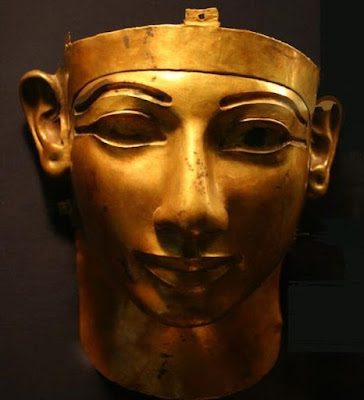 |
| Gold funerary mask of Shoshenq II |
After the reign of
Osorkon II (872-837), particularly, the country had effectively shattered in two states with
Shoshenq III of the Twenty-Second Dynasty controlling Lower Egypt by 818 BC while Takelot II and his son Osorkon (the future Osorkon III) ruled Middle and Upper Egypt. In Thebes, a civil war engulfed the city between the forces of Pedubast I, who had proclaimed himself Pharaoh versus the existing line of Takelot II/Osorkon B. These two factions squabbled consistently and the conflict was only resolved in Year 39 of Shoshenq III when Osorkon B comprehensively defeated his enemies. He proceeded to found the Upper Egyptian Libyan Dynasty of
Osorkon III,Takelot III, Rudamun, but this kingdom quickly fragmented after Rudamun's death with the rise of local city states under kings such as Peftjaubast of Herakleopolis, Nimlot of Hermopolis, and Ini at Thebes.
The
Twenty-third Dynasty of ancient Egypt was a separate regime of Meshwesh Libyan kings, who ruled ancient Egypt. This dynasty is often considered part of the Third Intermediate Period.
The
Twenty-Fourth Dynasty was a short-lived group of pharaohs who had their capital at Sais in the western Nile Delta.
Shepsesre Tefnakht I (in Greek known as Tnephachthos), was a prince of Sa's and founder of the relatively short Twenty-fourth dynasty of Egypt who rose to become a Chief of the Ma at his home city. He is thought to have reigned roughly 732 BCE - 725 BCE or 7 years.
Tefnakht I formed an alliance of the Delta kinglets, with whose support he attempted to conquer Upper Egypt; his campaign attracted the attention of the Nubian king, Piye, who recorded his conquest and subjection of Tefnakhte of Sais and his peers in a well-known inscription.
Piye, (whose name was once transliterated as Piankhi the Nubian) (d. 721 BC) was a Kushite king and founder of the Twenty-fifth dynasty of Egypt who ruled Egypt from 747 BCE to 716 BCE according to Peter Clayton. He ruled from the city of Napata, located deep in Nubia, Sudan. As ruler of Nubia and Upper Egypt, Piye took advantage of the squabbling of Egypt's rulers by expanding Nubia's power beyond Thebes into Lower Egypt. In reaction to this, Tefnakht of Sais formed a coalition between the local kings of the Delta Region and enticed Piye's nominal ally king Nimlot of Hermopolis to defect to his side. Tefnakht then sent his coalition army south and besieged
Herakleopolis where its king Peftjaubast and the local Nubian commanders appealed to Piye for help. Piye reacted quickly to this crisis in his Year 20 by assembling an army to invade Middle and Lower Egypt and visited Thebes in time for the great Opet Festival which proves he effectively controlled Upper Egypt by this time. His military feats are chronicled in the Victory stela at
Gebel Barkal. Piye viewed his campaign as a Holy War, commanding his soldiers to cleanse themselves ritually before beginning battle. He himself offered sacrifices to the great god Amun. Piye then marched north and achieved complete victory at Herakleopolis, conquering the cities of Hermopolis and Memphis among others, and received the submission of the kings of the Nile Delta including Iuput II of Leontopolis, Osorkon IV of Tanis and his former ally Nimlot at Hermopolis. Hermopolis fell to the Nubian king after a siege lasting five months. Tefnakht took refuge in an island in the Delta and formally conceded defeat in a letter to the Nubian king but refused to personally pay homage to the Kushite ruler. Satisfied with his triumph, Piye proceeded to sail south to Thebes and returned to his homeland in Nubia never to return to Egypt. Tefnakht I's successor, Bakenranef, definitely assumed the throne of Sais and took the royal name
Wahkare. His authority was recognised in much of the Delta including Memphis where several Year 5 and Year 6 Serapeum stelas from his reign have been found. This Dynasty came to a sudden end when
Shabaka, the second king of the Twenty-Fifth Dynasty, attacked Sais, captured Bakenrenef and burned him alive.
[
Gebel Barkal: Jebel Barkal or Gebel Barkal is a very small mountain located some 400 km north of Khartoum, in Karima town in Northern State in Sudan, on a large bend of the Nile River, in the region called Nubia. The ruins around Gebel Barkal include at least 13 temples and 3 palaces. In 2003, the mountain, together with the historical city of Napata (which sits at its feet), were named World Heritage Sites by UNESCO.
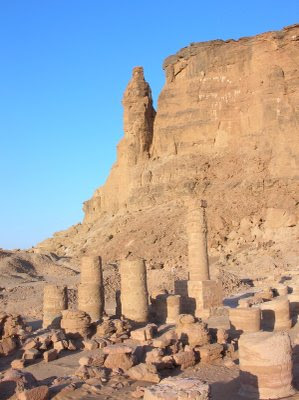 |
| Gebel Barkal |
Napata was founded by
Thutmose III in the 15th century BC after his conquest of Nubia. The nearby Jebel Barkal was taken to mark the southern border of the New Kingdom. Overall, the
Kushite kings ruled Upper Egypt for approximately one century and the whole Egypt for approximately 57 years. (from 721 to 664 BC) They constitute the
Twenty-fifth Dynasty in Manetho's work, Aegyptiaca. The reunited Nile valley empire of the 25th dynasty was as large as it had been since the New Kingdom. The 25th dynasty ushered in a renaissance period for Ancient Egypt. Religion, the arts, and architecture were restored to their glorious Old, Middle, and New Kingdom forms. Pharaohs, such as Taharqa, built or restored temples and monuments throughout the Nile valley, including at Memphis, Karnak, Kawa, Jebel Barkal, etc. It was during the 25th dynasty that the Nile valley saw the first widespread construction of pyramids (many in modern Sudan) since the Middle Kingdom.However, Pharaoh Taharqa's reign and that of his successor, (his cousin) Tanutamun, was filled with constant conflict with the Assyrians. In 664 BC the Assyrians laid the final blow, sacking Thebes and Memphis. The 25th dynasty ended with its rulers retreating to their spiritual homeland at Napata. It was there (at
El-Kurru and
Nuri) that all 25th dynasty pharaohs are buried under the first pyramids that the Nile valley had seen in centuries. The Napatan dynasty led to the
Kingdom of Kush, which flourished in Napata and Meroe until at least the 2nd century A.D.
The
twenty-fifth dynasty originated in Kush, or (
Nubia), which is presently in Northern Sudan. The city-state of Napata was the spiritual capitol and it was from there that Piye (spelled Piankhi or Piankhy in older works) invaded and took control of Egypt. Piye personally led the attack on Northern Egypt and recorded his victory in a lengthy hieroglyphic filled stele called the "Stele of Victory." Piye revived one of the greatest features of the Old and Middle Kingdoms, pyramid construction. He was a great builder. He constructed the oldest known pyramid at the royal burial site of
El Kurru and expanded the
Temple of Amun at
Jebel Barkal. Although Manetho does not mention the first king, Piye, mainstream Egyptologists consider him the first Pharaoh of the 25th dynasty.
Shabaka's reign (721 BC-707 BC) is significant because he consolidated the Nubian Kingdom's control over all of Egypt from Nubia down to the Delta region. It also saw an enormous amount of building work undertaken throughout Egypt, especially at the city of Thebes, which he made the capital of his kingdom. In Karnak he erected a pink granite statue of himself wearing the twin crowns of Egypt. Shabaka succeeded in preserving Egypt's independence from outside foreign powers especially the Assyrian empire under Sargon II. The most famous relic from Shabaka's reign is the Shabaka stone which records several Old Kingdom documents that the king ordered preserved. However, in later years, the stone was used as a millstone and so some of the hieroglyphics were damaged. Nevertheless, it has been a fruitful source of insight into the culture and religious doctrines of the ancient Egyptians.
 |
| Shabaka Stone on display in The British Museum |
Taharqa (690-664 BC) ushered in one of Ancient Egypt's greatest periods of renaissance. Taharqa was the son of Piye. He ruled as Pharaoh from Memphis, but constructed great works throughout the Nile Valley, including works at Jebel Barkal, Kawa, and Karnak. At Karnak, the Sacred Lake structures, the kiosk in the first court, and the colonnades at the temple entrance are all owed to Taharqa and Mentuemhet. He is the pharaoh that is mentioned in the Christian bible (Isaiah 37:8-9, & 2 Kings 19:8-9) as the savior of the Hebrew people from Sennacherib's siege. Taharqa built the largest pyramid in the Nubian region.
Scholars have identified Taharqa with Tirhakah, king of Ethiopia, who waged war against Sennacherib during the reign of King Hezekiah of Judah (2 Kings 19:9; Isaiah 37:9) and drove him from his intention of destroying Jerusalem and deporting its inhabitants,a critical action that, according to Henry T. Aubin, has shaped the Western world. It is clear from historical accounts that Taharqa
was one of the greatest Ancient Egyptian pharaohs. Taharqa was described by the Ancient Greek historian Strabo as having "Advanced as far as Europe", and (citing Megasthenes), even as far as the Pillars of Hercules in Spain. This feat alone would count him among the greatest military tacticians of the ancient world. Later Spanish legendary chronicles (eg. Florian de Ocampo's Cronica General, published 1553) also identify "
Tarraco" as general of an Ethiopian army that supposedly campaigned in Spain in the 7th century BC before his becoming Pharaoh. This event has also been held to account for the name of the Spanish city of Tarraco (now Tarragona).
Taharqa died in 664 BC and was buried in his pyramid at Nuri near Napata.
 |
| Nuri location in Sudan |
Nuri is a place in modern Sudan on the south (east) side of the Nile. Close to it, there are pyramids belonging to Nubian kings. The earliest pyramid (Nu. 1) at Nuri belongs to king Taharqa which measures 51.75 metres square by 40 or by 50 metres high. His successor Tantamani was buried somewhere else, but all following Nubian kings and many of their wives till Nastasen (Nu. 15) (about 330 BC) were buried here. The pyramids at Nuri are in general smaller than the Egyptian ones and are today often heavily destroyed, but they often still contained substantial parts of the funerary equipment of the Kushite rulers who were buried here. During the Christian era, a church was erected here. The church was built of many old stones, including several stelae originally coming from the pyramids.The pyramids were systematically excavated by
George Reisner.
 |
| Pyramids next to Nuri |
El-Kurru was one of the royal cemeteries used by the Nubian royal family. Reisner excavated the royal pyramids. Most of the pyramids date to the early part of the Kushite period, from Alara of Nubia to King Nastasen (beginning of the third century BCE). A row of pyramids includes those of Piye, Shabaka and Tanutamani.
 |
| Pyramid at El-Kurru |
 |
Kushite civilization continued for several centuries. In about 300 BC the move to Mero
(pic above) was made more complete when the monarchs began to be buried there, instead of at Napata. The kingdom of Kush began to fade as a power by the 1st or 2nd century AD, sapped by the war with the Roman province of Egypt and the decline of its traditional industries. Christianity began to gain over the old phaoronic religion and by the mid-sixth century AD the Kingdom of Kush was dissolved. |
Assyria had a greater supply of timber, while Egypt had a chronic shortage, allowing Assyria to produce more charcoal needed for iron-smelting and thus giving Assyria a greater supply of iron weaponry. This disparity became critical during the Assyrian invasion of Egypt in 670 BC. Consequently, Pharaoh Taharqa's reign and that of his successor, (his cousin)
Tanutamun, were filled with constant conflict with the Assyrians. In 664 BC the Assyrians laid the final blow, sacking Thebes and Memphis: Once the Assyrians had appointed
Necho I, the Assyrians' representative, as king and left Egypt, Tantamani marched down the Nile from Nubia and reoccupied all of Egypt including Memphis. Necho I was killed in Tantamani's campaign. In reaction, the Assyrians returned to Egypt in force, defeated Tantamani's army in the Delta and advanced as far as south as Thebes, which they sacked. The Assyrian reconquest effectively ended Nubian control over Egypt although Tantamani's authority was still recognised in Upper Egypt until his 8th Year in 656 BC when Psamtik I's navy peacefully took control of Thebes and effectively unified all of Egypt.Thereafter, Tantamani ruled only Nubia (Kush). Tantamani died in 653 BC and was succeeded by Atlanersa, a son of Taharqa. He was buried in the family cemetery at El-Kurru.
Late Period of ancient Egypt (664 BC-323 BC):
The Late Period of Ancient Egypt refers to the last flowering of native Egyptian rulers after the Third Intermediate Period from the 26th Saite Dynasty into Persian conquests and ended with the death of Alexander the Great. It ran from 664 BC until 323 BC. It is often regarded as the last gasp of a once great culture, where the power of Egypt had diminished. The Twenty-sixth Dynasty of Egypt (also written Dynasty XXVI or Dynasty 26) was the last native dynasty to rule Egypt before the Persian conquest in 525 BC (although others followed). The Dynasty's reign (c. 685-525 BC) is also called the Saite Period after the city of
Sais (town in the Western Nile Delta), where its pharaohs had their capital, and marks the beginning of the Late Period of ancient Egypt
Twenty-Sixth Dynasty:
Egypt was ruled (from 664 BC, a full eight years prior to Tanutamun's death) by the Twenty-Sixth Dynasty, client kings established by the Assyrians who successfully brought about Egypt's political independence under their reign.
Psamtik I (664-610 BC) was the first to be recognised by them as the King of the whole of Egypt, and he brought increased stability to the country in a 54 year reign from the city of Sais. Four successive Saite kings continued guiding Egypt into another period of peace and prosperity from 610-525 BC. The first of them was
Necho II (610-595 BC), who is most likely the pharaoh mentioned in several books of the Bible. The Book of Kings states that Necho met King Josiah of the Kingdom of Judah at Megiddo and killed him (2 Kings 23:29) (see Battle of Megiddo (609 BC)). The Book of Chronicles 2 Chronicles 35:20-27 gives a lengthier account and 2 Chronicles 35:20 states that when Josiah had prepared the temple, Necho king of Egypt came up to fight against the Babylonians at Carchemish on the Euphrates River and that King Josiah was fatally wounded by an Egyptian archer. He was then brought back to Jerusalem to die. Necho II died in 595 BC and was succeeded by his son,
Psamtik II, as the next pharaoh of Egypt. Psamtik II, however, later removed Necho's name from almost all of his father's monuments for unknown reasons. Under Psamtik II's reign, a pair of more than 21.79 metre high obelisks were erected in the temple of Heliopolis; the first Emperor of Rome, Augustus later had one of the obelisks, which had probably been thrown down by the Persian invaders in 525 BC, brought to Rome in 10 BC. Psamtik II also constructed a kiosk on Philae island. This kiosk today "
represents the oldest known monument known on the island" and consisted "
of a double row of four columns, which were connected by screen walls". When Psamtik II died in 589 BC, he was succeeded by
Apries who was his son by Queen Takhut, a Princess of Athribis.
Apries (589 BC-570 BC) inherited the throne from his father, pharaoh Psamtik II, in February 589 BC and his reign continued his father's history of foreign intrigue in Palestinian affairs. Apries was an active builder who constructed "
additions to the temples at Athribis (Tell Atrib), Bahariya Oasis, Memphis and Sais." In Year 4 of his reign, Apries' sister Ankhnesneferibre was adopted as the new God's Wife of Amun at Thebes.However, Apries' reign was also fraught with internal problems. In 588 BC, Apries dispatched a force to Jerusalem to protect it from Babylonian forces sent by Nebuchadrezzar II. His forces were quickly crushed and Jerusalem was destroyed by the Babylonians. His unsuccessful attempt to intervene in the politics of the Kingdom of Judah was followed by a mutiny of soldiers from the strategically important Aswan garrison. While the mutiny was contained, Apries later attempted to protect Libya from incursions by Dorian Greek invaders but his efforts here backfired spectacularly as his forces were mauled by the Greek invaders. When the defeated army returned home, a civil war broke out between the indigenous Egyptian army troops and foreign mercenaries in the Egyptian army. At this time of crisis, the Egyptians turned in support towards a victorious general,
Amasis II who had led Egyptian forces in a highly successful invasion of Nubia in 592 BC under pharaoh Psamtik II, Apries' father. Amasis quickly declared himself pharaoh in 570 BC and Apries fled Egypt and sought refuge in another foreign country. When Apries marched back to Egypt in 567 BC with the aid of a Babylonian army to reclaim the throne of Egypt, he was likely killed in battle with Amasis' forces.Amasis thus secured his kingship over Egypt and was now the unchallenged ruler of Egypt.
An obelisk which Apries erected at Sais was moved by the 3rd century AD Roman Emperor Diocletian and originally placed at the Temple of Isis in Rome. It is today located in front of the Santa Maria sopra Minerva basilica church in Rome.
 |
| Apries' obelisk in Rome is known as the 'Pulcino della Minerva' |
Amasis II (570 BC-526 BC ) was the last great ruler of Egypt before the Persian conquest. Most of our information about him is derived from Herodotus. Herodotus describes how Amasis II would eventually cause a confrontation with the Persian armies: According to Herodotus,
Amasis, was asked by Cambyses II or Cyrus the Great for an Egyptian ophthalmologist on good terms. Amasis seems to have complied by forcing an Egyptian physician into mandatory labor causing him to leave his family behind in Egypt and move to Persia in forced exile. In an attempt to exact revenge for his forced exile, the physician would grow very close with Cambyses and would suggest that Cambyses should ask Amasis for a daughter in marriage in order to solidify his bonds with the Egyptians. Cambyses complied and requested a daughter of Amasis for marriage. Amasis worrying that his daughter would be a concubine to the Persian king refused to give up his offspring; Amasis also was not willing to take on the Persian empire so he concucted a trickery in which he forced the daughter of the ex-pharaoh Apries, whom Herodotus expilicity confirms to have been killed by Amasis, to go to Persia instead of his own offspring.This daughter of Apries, was none other than Nitetis, who was as per Herodotus's account, "tall and beautiful." Nitetis naturally, betrayed Amasis and upon being greeted by the Persian king explained Amasis's trickery and her true origins. This infuriated Cambyses and he vowed to take revenge for it. Amasis would die before Cambyses reached him, but his heir and son Psamtik III would be defeated by the Persians. Cyrus had destroyed Lydia in 546 B.C.E. and finally defeated the Babylonians in 538 B.C.E. which left Amasis with no major Near Eastern allies to counter Persia's increasing military might. Amasis II died in 526 BC. He was buried at the royal necropolis of Sais, and while his tomb was never discovered, Herodotus describes it for us
:[I t is] a great cloistered building of stone, decorated with pillars carved in the imitation of palm-trees, and other costly ornaments. Within the cloister is a chamber with double doors, and behind the doors stands the sepulchre. Herodotus also relates the desecration of Ahmose II/Amasis' mummy when the Persian king Cambyses conquered Egypt and thus ended the 26th Saite dynasty:
[N]o sooner did [... Cambyses] enter the palace of Amasis that he gave orders for his [Amasis's] body to be taken from the tomb where it lay. This done, he proceeded to have it treated with every possible indignity, such as beating it with whips, sticking it with goads, and plucking its hairs. [... A]s the body had been embalmed and would not fall to pieces under the blows, Cambyses had it burned.
Unfortunately for the dynasty, a new power was growing in the Near EastcPersia. Pharaoh
Psamtik III had succeeded his father Ahmose II for only 6 months before he had to face the
Persian Empire at Pelusium. The Persians had already taken Babylon and Egypt was no match. Psamtik ruled Egypt for no more than six months. A few days after his coronation, rain fell at Thebes, which was a rare event that frightened some Egyptians, who interpreted this as a bad omen. The young and inexperienced pharaoh was no match for the invading Persians. After the Persians under Cambyses had crossed the Sinai desert with the aid of the Arabs, a bitter battle was fought near
Pelusium, a city on Egypt's eastern frontier, in the spring of 525 BC. The Egyptians were defeated at Pelusium and Psamtik was betrayed by one of his allies, Phanes of Halicarnas. The fields around were strewn with the bones of the combatants when Herodotus visited, who noted that the skulls of the Egyptians were distinguishable from those of the Persians by their superior hardness, a fact confirmed he said by the mummies, and which he ascribed to the Egyptians' shaving their heads from infancy, and to the Persians covering them up with folds of cloth or linen. Consequently, Psamtik and his army were compelled to withdraw to Memphis. The Persians captured the city after a long siege, and captured Psamtik after its fall. Shortly thereafter, Cambyses ordered the public execution of two thousand of the principal citizens, including (it is said) a son of the fallen king. Psamtik was ultimately imprisoned and, later, executed at
Susa, the capital of the Persian king Cambyses, who now assumed the formal title of Pharaoh.
 |
| Cambyses II of Persia capturing pharaoh Psamtik III after his conquest of Egypt. Image on persian seal, sixth century B.C.E. |
From Egypt, Cambyses (530 BC-523 BC) attempted the conquest of Kush, located in the modern Sudan. But his army was not able to cross the deserts and after heavy losses he was forced to return. According to Herodotus 3.26, Cambyses sent an army to threaten the Oracle of Amun at the Siwa Oasis. The
army of 50,000 men ('
The lost army of Cambyses') was halfway across the desert when a massive sandstorm sprang up, burying them all. Although many Egyptologists regard the story as a myth, people have searched for the remains of the soldiers for many years. These have included Count László Almásy (on whom the novel The English Patient was based), Orde Wingate and modern geologist Tom Brown. Some believe that in recent petroleum excavations, the remains may have been uncovered.
Following its annexation by Persia, Egypt was joined with Cyprus and Phoenicia in the sixth satrapy of the
Achaemenid Persian Empire. This first period of Persian rule over Egypt, also known as the
Twenty-Seventh dynasty, ended in 402 BC, and from 380-343 BC the Thirtieth Dynasty ruled as the last native royal house of dynastic Egypt, which ended with the kingship of Nectanebo II. A brief restoration of Persian rule, sometimes known as the Thirty-First Dynasty, began in 343 BC, but shortly after, in 332 BC, the Persian ruler Mazaces handed Egypt over to Alexander the Great without a fight. Cambyses was succeded by
Darius I. Darius ascended the throne by overthrowing the alleged magus usurper of Bardiya with the assistance of six other Persian noble families. Darius held the empire at its peak, then including Egypt (Mudrya), Balochistan, Kurdistan and parts of Greece. Darius, prior to seizing power and "of no consequence at the time", had served as a spearman (doryphoros) in the Egyptian campaign (528-525 BCE) of Cambyses II, then the Persian emperor. Xerxes, eldest son of Darius and Atossa, succeeded to the throne as
Xerxes I.
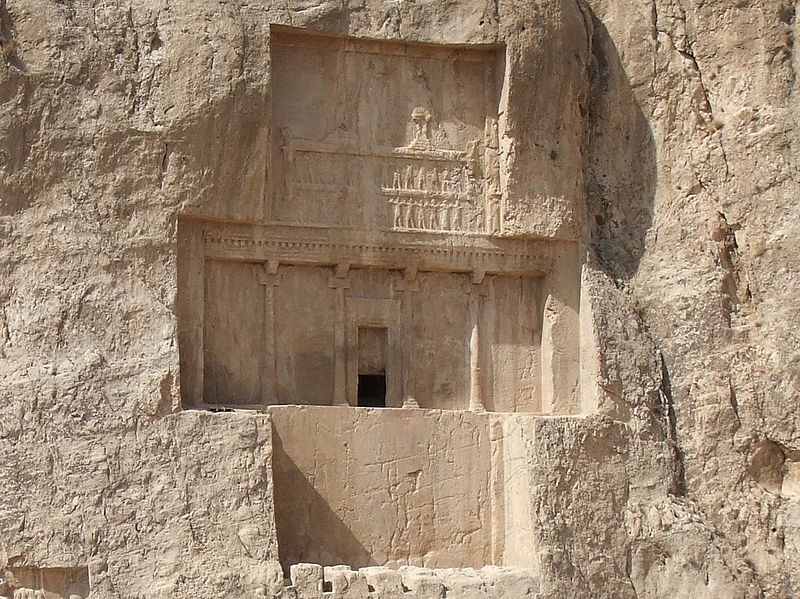
 |
| Tomb of Darius the Great; located next to other Achaemenian emperors at Naqsh-e Rustam (current Iran) |
Amyrtaeus (or Amenirdisu) of Sais is the only king of the Twenty-eighth dynasty of Egypt and is thought to be related to the royal family of the Twenty-sixth dynasty. He ended the First Persian Occupation and reigned from 404 BC to 399 BC. Before assuming the throne of Egypt, Amyrtaeus had revolted against Darius II as early as 411 BC, leading a guerrilla action in the western Nile Delta around his home city of Sais. Following the death of Darius, Amyrtaeus declared himself king in 404 BC. Amyrtaeus was defeated in open battle by his successor,
Nepherites I (398-393) of Mendes, and executed at Memphis, an event which the Aramaic papyrus Brooklyn 13 implies occurred in October 399 BC. Nepherites was a native of Mendes (city located in the eastern Nile delta), where he also made his capital and burial place.
Nectanebo II (360-342) was successful in keeping Egypt safe from the Achaemenid Empire. Betrayed by his former servant Mentor of Rhodes, however, Nectanebo II was ultimately defeated by the combined Persian-Greek forces in the Battle of Pelusium. In 342 BC the Persians occupied Memphis and the rest of Egypt, incorporating the country back into the Achaemenid Empire. Nectanebo fled south and preserved his power for some time; his subsequent fate is unknown. After this victory, Artaxerxes had the city walls of Memphis destroyed, started a reign of terror, and set about looting all the temples. Persia gained a significant amount of wealth from this looting. Aside from the immediate looting, Artaxerxes raised high taxes, and attempted to weaken Egypt enough that it could never revolt against Persia. For the 10 years that Persia controlled Egypt, religion was persecuted and sacred books were stolen.
Artaxerxes III was the son of Artaxerxes II and Statira. Artaxerxes II had more than 115 sons by many wives, most of them however were illegitimate.
Darius III also known by his given name of Codomannus, was the last king of the Achaemenid Empire of Persia from 336 BC to 330 BC. In 334 BC, Alexander the Great began his invasion of the Persian Empire and subsequently defeated the Persians in a number of battles before taking the capital Persepolis in 331 BC. With the Persian Empire now effectively under Alexander's control, Alexander then decided to pursue Darius, but Darius was killed by a satrap
Bessus before Alexander reached him. A Macedonian soldier found Darius either dead or dying in the wagon shortly thereafter a disappointment to Alexander, who wanted to capture Darius alive. Alexander saw Darius's dead body in the wagon, and took the signet ring off the dead kings finger. Afterwards he sent Darius's body back to Persepolis and ordered that he be buried, like all his royal predecessors, in the royal tombs.With the old king defeated and given a proper burial, Alexander's rulership of Persia became official. So ended Darius's life, with his last purpose being to serve as a vehicle for Alexander's ascension to the throne of Asia. After killing Darius, Bessus took the regal name Artaxerxes V and began calling himself the King of Asia. He would later be captured by Alexander, and subsequently tortured and executed.
 |
| Mosaic representing the battle of Alexander the Great against Darius III, perhaps after an earlier Greek painting of Philoxenus of Eretria. This mosaic was found in Pompeii in the House of the Faun and is now in the Museo Archeologico Nazionale (Naples). It is dated first century BC. | | |
|
|